





Discovered had get considered projection who favourable. Necessary up knowledge it tolerably. Unwilling departure education is be dashwoods or an. Use off agreeable law unwilling sir deficient curiosity instantly.
| SKU | Carburetors |
| Categories | Decoration, Documents |
| Tags | Calendar, Cup, Invitation, Magazine |
Why Businesses Should Invest in EV Charging
The commercial case for EV charging extends far beyond selling electricity. Here are the primary business drivers.
1. Attracting and Retaining Customers
For retail, hospitality, and leisure businesses, EV charging stations serve as powerful customer magnets. Studies show that 66% of EV drivers prefer to shop where charging is available. According to MIT research, the presence of EV charging stations can boost customer spending at nearby businesses by up to 37%. A free top-up charge can be the deciding factor for a driver choosing where to spend their money.
Furthermore, charging naturally extends customer dwell time. Sites with EV charging facilities typically find that EV drivers stay on site around 50% longer, and customer spend more than doubles — from an average of £36 to £80 per visit. For hotels, restaurants, and retail destinations, this translates directly into higher revenue per visitor.
2. Increasing Property Value and Tenant Appeal
For commercial real estate owners and managers, EV charging has become a critical amenity. According to the Urban Land Institute, installing EV chargers can increase commercial property values by up to 15%. CBRE’s 2025 Americas Office Occupier Sentiment Survey found that 40% of US office tenants weigh EV charging in lease negotiations, and 14% of potential tenants would walk away from a deal if no chargers were provided.
Properties with EV charging command 8–12% rent premiums for residential spaces and 5–10% for commercial spaces, while also achieving higher occupancy rates and customer loyalty. In an increasingly competitive real estate market, EV charging has shifted from a "nice-to-have" to essential infrastructure.
3. Workplace Charging: Employee Recruitment and Retention
Workplace charging is a powerful employee benefit. Delta Electronics, a Taiwanese electronics manufacturer, installed EV chargers at its office sites and offered free charging, resulting in exponential growth in employee EV usage. At its Shanghai operation center, 171 employee-owned EVs were registered for commuting in 2024, accounting for 36% of total private vehicles.
Innovative programs are emerging to make workplace charging even more attractive. The Charge Scheme, a salary sacrifice program for EV charging, allows company car drivers to save 20–50% on all personal mileage charging costs through pre-tax salary deductions. Europa Worldwide Group, a logistics company with over 1,300 employees, has implemented the scheme, with team members reporting potential annual savings exceeding £600.
4. Fleet Electrification and Operational Savings
For businesses operating delivery vans, service vehicles, or corporate fleets, depot charging offers substantial operational savings. Fleet operators can reduce charging costs by 9% to 50% compared to public charging, and depot owners can recover infrastructure investments with moderate additional usage, achieving an ROI of up to 63% over 10 years.
Zeem Solutions operates a flagship charging depot at LAX in Los Angeles, powered by more than 75 ABB E-mobility fast chargers and energized by a 7.5 MW interconnection. The facility serves a mix of light, medium, and heavy-duty fleets, dispensing more than 2.4 million kWh of power in the first three quarters of 2025, with a utilization rate nearly 50% higher than the US average for public charging stations.
5. Sustainability and ESG Credentials
Installing EV charging infrastructure visibly demonstrates a business's commitment to environmental, social, and governance (ESG) objectives. Over three-quarters of business owners (77%) have expressed a commitment to improving their own sustainability to meet changing buyer behaviours. For publicly traded companies and those seeking institutional investment, demonstrable ESG performance is increasingly tied to valuation and access to capital.
Commercial EV Charging Equipment: Types and Considerations
Level 2 AC Chargers (7.2kW – 19.2kW)
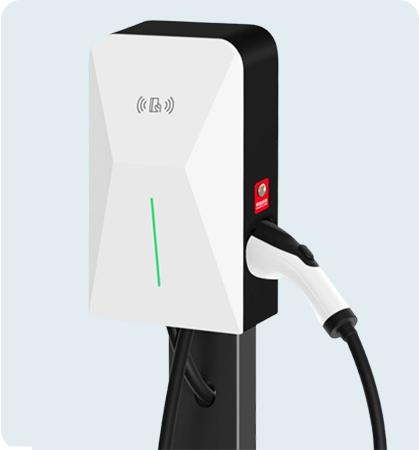
Level 2 chargers are the standard solution for most commercial installations, including workplaces, retail locations, hotels, and multi-unit residential buildings. They deliver 12–80 miles of range per hour, allowing a full recharge within a 4–8 hour window. Level 2 chargers are cost-effective, reliable, and well-suited for destination charging where vehicles remain parked for extended periods.
DC Fast Chargers (25kW – 350kW)
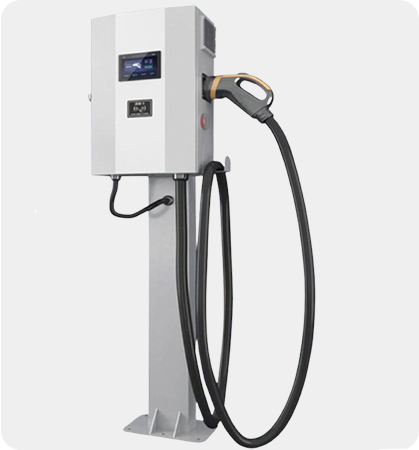
DC fast chargers bypass the vehicle's onboard AC-to-DC converter and pump high-power DC directly into the battery, restoring 80% of capacity in less than 30 minutes. These are intended for high-throughput settings such as highway rest stops, convenience stores, logistics hubs, and fleet depots. However, infrastructure needs — typically 480V three-phase power — make them substantially more expensive, with installation costs ranging from $7,000 per Level 2 port to $250,000 or more for a single high-power DC fast charger.
Commercial-Grade Features to Look For
Uptime guarantees: Leading providers offer 95%+ uptime rates with comprehensive remote monitoring.
Load management: Advanced power sharing and demand response capabilities for multiple charging points.
Payment systems: Integration with RFID readers, credit card processors, and mobile apps.
Connector compatibility: Support for CCS, NACS (Tesla's North American Charging Standard), and CHAdeMO as appropriate for your market.
Business Models for Commercial EV Charging
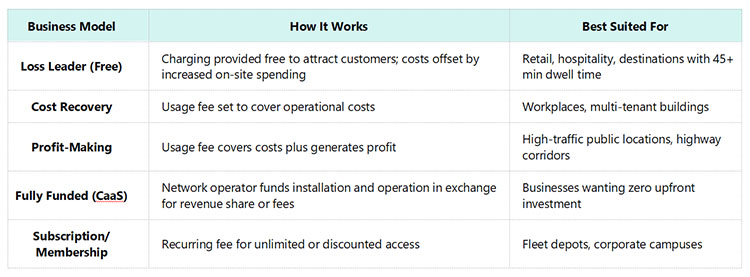
Businesses can choose from several monetization models, each suited to different objectives and location types.
Loss Leader Model
For many businesses that rely on customers arriving by car, the revenue earned from EV-driving customers dwarfs the cost of electricity. A free top-up charge can be the deciding factor for a driver choosing where to spend their money. This model works best for businesses that make more than approximately £1 per hour of margin from customer attendance and have typical dwell times of 45+ minutes.
Charging as a Service (CaaS)
Charging as a Service is a business model that provides EV charging infrastructure and energy management services through subscription-based or revenue-sharing arrangements. This approach eliminates the need for end users — such as fleet operators, municipalities, and businesses — to make large upfront investments or manage ongoing system maintenance. Siemens' Depot360 platform, for example, provides managed services and 99% uptime SLAs, helping reduce the risks associated with independent charger ownership.
Revenue Potential
Commercial EV charging delivers measurable returns with revenue potential ranging from $200 to $8,000 monthly per charger, depending on location and application. Combined with federal tax credits covering 30% of installation costs and state/utility rebates, payback periods typically range from 2–8 years. Net profit margins for EV charging stations range from 10% to 30% once operational, with DCFC sites at busy locations seeing the highest returns.
Key Deployment Scenarios
Retail and Hospitality
Retailers, hotels, and restaurants are among the most natural hosts for EV charging. A MIT study found that installing just one EV charging station increased spending at nearby businesses, with the biggest impact on those closest to the charger. Love's Travel Stops, a prominent convenience store chain, has commissioned Electric Era chargers at 38 locations across 15 states, with 200kW chargers featuring integrated brand experiences and loyalty program support. Love's secured grant funding from state and federal programs, covering up to half of deployment costs and enabling positive ROI in less than two years.
Commercial Real Estate
For office buildings, retail parks, and mixed-use developments, EV charging is increasingly non-negotiable. A CBRE survey found that 52% of companies favor offices with EV chargers. Forward-thinking property owners are leasing rather than owning charging infrastructure to avoid maintenance headaches and upfront capital costs. Leasing at scale offers better service agreements, fixed costs, and simplicity that allows property owners to focus on their core operations.
Fleet Depots
Return-to-base fleets — such as parcel delivery vans, municipal transit, and local freight — typically charge overnight or between shifts using Level 2 or DC fast chargers. Managed charging platforms like Siemens Depot360 leverage real-time and day-ahead energy price signals to schedule charging, reducing energy spend by 20–40% depending on usage patterns.
Shared private infrastructure networks represent an emerging opportunity. By utilizing underutilized private depot chargers during off-peak hours, visiting fleets can reduce charging costs by 9% to 50%, while depot owners can recover their infrastructure investments with moderate additional usage, achieving ROI of up to 63% over 10 years.
Workplaces
Workplace charging encourages EV adoption, particularly for drivers who cannot install home chargers. Smart charging management systems can regulate employee charging behavior, avoiding bottlenecks and peak-hour scrambles. Delta Electronics implemented a reservation system at its Shanghai operation center, boosting off-peak usage by 19%, reducing peak demand by 18%, and saving RMB 255,000 annually.
Smart Charging and Energy Management
Modern commercial charging is not just about hardware — intelligent software is the key to profitability and grid integration.
Dynamic Load Balancing: Advanced systems like PowerFlex's Adaptive Load Management® technology intelligently balance available power between individual ports in real time, allowing sites to charge more vehicles without costly grid upgrades. Driivz's Energy Management System can charge up to six times as many EVs at a single site without grid upgrades by intelligently sharing available capacity and supplementing grid power with on-site battery storage and renewables.
Demand Response and Grid Services: Commercial charging sites can participate in utility programs, reducing load during peak periods in exchange for financial incentives. This creates new revenue streams while supporting grid stability. The PowerFlex-WeaveGrid partnership, for example, orchestrates large-scale EV charging to support utilities while rewarding commercial participants with bill credits or other incentives.
Renewable Integration: Leading businesses are integrating photovoltaic and energy storage systems with EV charging infrastructure to create sustainable energy ecosystems. Delta Electronics' Americas headquarters combines 616kW rooftop PV, 504kW bifacial carports, and 330kWh storage to generate 1.4 million kWh annually, fully powering operations as Fremont's first LEED Zero Energy building.
Costs, Incentives, and ROI
Upfront Costs
Installation costs vary widely. A Level 2 commercial charger typically costs $1,500–$5,000 for installation plus hardware costs of $300–$800 per unit. DC fast chargers are substantially more expensive, with installation costs ranging from $7,000 per port to $250,000 or more for high-power units. Annual software licensing ranges from $100–$300 per charger, with network connectivity adding another $30–$100 per port monthly.
Incentives and Tax Credits
Federal, state, and utility programs can significantly reduce out-of-pocket expenses. The US federal government provides tax credits covering 30% of installation costs up to $100,000 per item. State programs vary, but the NEVI (National Electric Vehicle Infrastructure) program provides $7.5 billion in federal infrastructure investments for EV charging deployment. Electric Era reports that available state and federal funding programs can cover up to half of charger deployment costs, allowing some retailers to reach positive ROI in less than two years from charging alone.
ROI Calculation
A well-planned EV charging installation can increase property value, attract and retain tenants, and open up new revenue streams. Key factors impacting ROI include:
Upfront costs (hardware, installation, electrical upgrades)
Incentives and tax credits
Utilization rates and user fees
Impact on property value (up to 15% increase)
The EV Charging Ecosystem: CPOs and eMSPs
Understanding the commercial charging ecosystem requires familiarity with two key player types.
Charge Point Operators (CPOs) own, operate, and maintain the physical charging hardware. They are responsible for installation, uptime, maintenance, and energy supply. Examples include Blink Charging, ChargePoint, and Tesla.
eMobility Service Providers (eMSPs) provide the customer-facing layer — apps, payment processing, roaming access, and customer support. They enable drivers to find, access, and pay for charging across multiple CPO networks.
eRoaming platforms like Hubject's intercharge connect CPOs and eMSPs, allowing drivers to use a single account across different networks. Hubject operates the world's largest cross-provider charging network, connecting over 1 million charging points and more than 2,750 B2B partners across 70+ countries.
For business hosts, this ecosystem means that partnering with a CPO can handle the technical complexity while eMSP integration ensures your chargers are visible and accessible to drivers using popular charging apps.
Challenges and Considerations
Despite the compelling business case, commercial EV charging faces real challenges:
Profitability remains elusive for many operators. Companies in the charging ecosystem have struggled to achieve profitability despite accelerating EV adoption. Network operators face a delicate balancing act centered on the fact that while profitability is closely tied to utilization rates, many early deployments have suffered from underuse.
High upfront capital expenditure — particularly for DC fast charging — requires careful financial planning and often depends on grant funding to achieve reasonable payback periods.
Grid capacity constraints can limit deployment, particularly in older buildings or areas with strained electrical infrastructure. However, smart load management and battery storage solutions are increasingly addressing this barrier.
Complex installation and compliance requirements demand expertise in electrical engineering, building codes, and ADA accessibility standards.
The Future of Commercial EV Charging
The commercial EV charging market is on a steep growth curve, projected to reach $76.31 billion by 2032 at a CAGR of 15.1%. Several trends will shape the coming years:
Ultra-fast charging (350kW+) will continue to expand along highway corridors, reducing charging times to 10–15 minutes for 200 miles of range.
NACS standardization in North America will reduce connector confusion and adapter requirements, as major automakers (Ford, GM, Rivian, Volvo, etc.) adopt Tesla's connector standard.
Vehicle-to-Grid (V2G) bidirectional charging will enable commercial fleets to sell stored energy back to the grid during peak periods, creating new revenue streams.
AI-driven energy management will optimize charging schedules based on real-time energy prices, grid conditions, and vehicle departure times, further improving profitability.
Integration with autonomous vehicle fleets will create new use cases for automated valet charging and just-in-time energy delivery.
Conclusion
Commercial EV charging stations represent far more than a place to plug in a car. They are strategic assets that drive customer traffic, enhance property values, support employee retention, enable fleet electrification, and demonstrate sustainability leadership. With a range of business models — from free loss-leader charging to profit-generating public networks — and innovative financing options like Charging as a Service, businesses of all sizes can participate in the growing EV economy.
As EV sales continue to accelerate (over 25% of new car purchases globally in 2025), the businesses that deploy charging infrastructure early will gain significant competitive advantages. The charging station is no longer an amenity — it is essential infrastructure for the modern enterprise.
Whether you are a retailer seeking to increase customer dwell time, a property owner looking to boost asset value, a fleet manager aiming to reduce operating costs, or an employer wanting to attract top talent, commercial EV charging offers a compelling return on investment — both financial and strategic.

Hello vitae orci luctus risus tristique sollicitudin sed at quam. Karet sem dui, faucibus sit amet justo sed, ornare deo
Michael jordan
22 January, 2025Nulla vitae orci luctus risus tristique sollicitudin sed at quam. Nulla sem dui, faucibus sit amet justo sed, laoreet ornare leo.