





Discovered had get considered projection who favourable. Necessary up knowledge it tolerably. Unwilling departure education is be dashwoods or an. Use off agreeable law unwilling sir deficient curiosity instantly.
| SKU | Carburetors |
| Categories | Decoration, Documents |
| Tags | Calendar, Cup, Invitation, Magazine |
E-Truck Charging Stations: Powering the Future of Heavy-Duty Freight
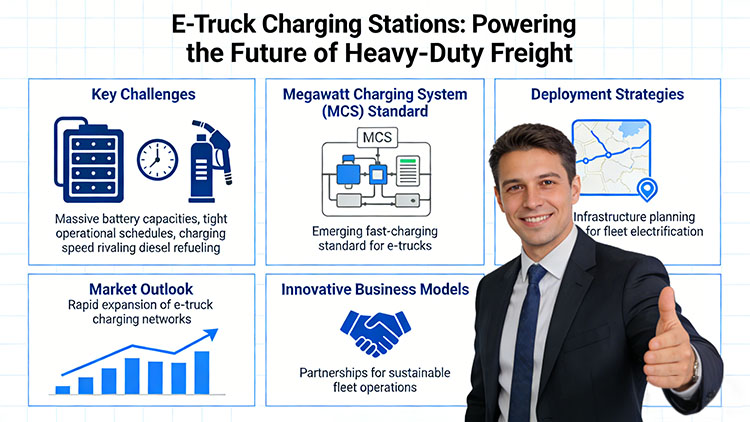
As the global transportation sector accelerates toward decarbonization, electric trucks (e-trucks) are emerging as a critical solution for reducing emissions from heavy-duty freight. However, unlike passenger electric vehicles (EVs), e-trucks present unique challenges: massive battery capacities, tight operational schedules, and the need for charging solutions that can rival diesel refueling in speed and reliability. The infrastructure that powers these vehicles—e-truck charging stations—is fundamentally different from anything seen in the passenger EV space. This article provides a comprehensive overview of e-truck charging technology, the emerging Megawatt Charging System (MCS) standard, deployment strategies, market outlook, and the innovative business models making fleet electrification a reality.
Why E-Truck Charging Is Different from Passenger EV Charging
Trucks are not simply larger cars. Their operational demands and energy requirements reshape the entire charging equation.
A typical battery-electric truck carries a battery pack of 800–900 kWh or more—roughly ten times the capacity of a passenger EV battery. For a fleet operating multiple trucks, the power demand becomes staggering. A depot with 20 electric trucks might require megawatt-scale grid connections that rival small industrial facilities. E-truck charging must also integrate seamlessly into logistics schedules: long-haul drivers take mandatory rest breaks (30 minutes in the US after 8 hours of driving), and charging must fit within those windows to avoid costly downtime.
Furthermore, e-truck charging stations must be engineered for heavy-duty use. Connectors and cables must withstand thousands of high-power charging cycles, thermal management systems must handle extreme heat loads, and the physical layout must accommodate large vehicles with standardized charging inlet positions.
The Megawatt Charging System (MCS): The Game-Changing Standard
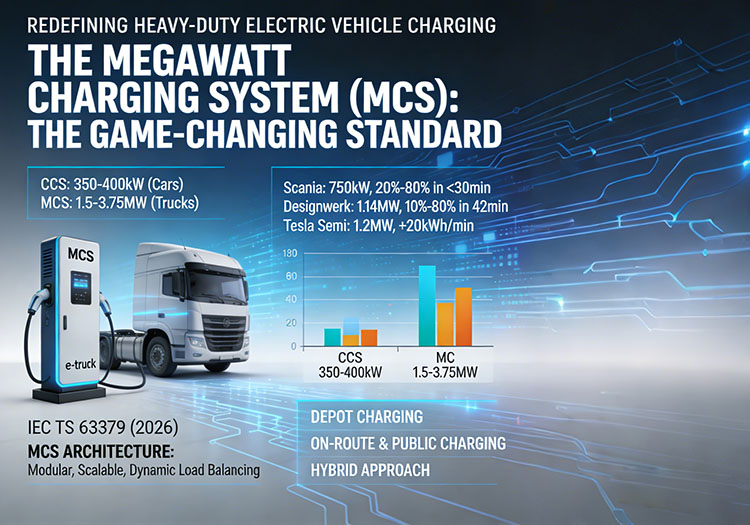
For years, e-truck charging relied on the Combined Charging System (CCS), the same standard used for passenger EVs. But CCS chargers typically deliver 350–400 kW—adequate for cars but far too slow for a 900 kWh truck battery. A full charge would take several hours, making long-haul electrification impractical.
The answer is the Megawatt Charging System (MCS), a purpose-built standard for heavy-duty vehicles. Unlike CCS, which was adapted from passenger car technology, MCS was created from the ground up for the realities of freight transport.
Technical Specifications
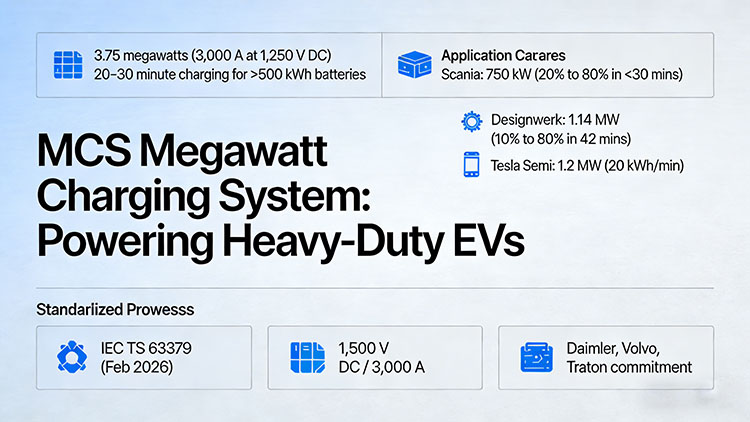
MCS is designed to deliver up to 3.75 megawatts of power (3,000 A at 1,250 V DC), enabling 20–30 minute charging times for heavy-duty vehicles with battery capacities exceeding 500 kWh. In practice, 1.5 MW is expected to become the standard for truck charging, with real-world demonstrations already achieving impressive results.
Scania, one of the leading truck manufacturers, announced the launch of MCS for its e-trucks with commercial availability from early 2026. Scania’s first MCS implementation delivers up to 750 kW—approximately twice as fast as today’s CCS2 standard—allowing a truck to charge from 20% to 80% in less than 30 minutes, seamlessly integrating into drivers‘ rest or break periods.
In real-world demonstrations, Designwerk Technologies achieved a peak charging power of 1.14 MW in Switzerland, charging a prototype e-truck with a 1,000 kWh battery from 10% to 80% in 42 minutes with an average power of 906 kW—described as the highest continuous charging rate for the application. Tesla has also demonstrated its Semi truck charging at 1.2 MW, adding approximately 20 kWh of energy every minute.
Standardization Progress
The MCS standard is now formally established. In February 2026, CharIN announced the publication of IEC TS 63379, a Technical Specification from the International Electrotechnical Commission (IEC) defining connectors, vehicle inlets, and cable assemblies for megawatt-level DC charging. The specification supports system voltages of up to 1,500 V DC and currents of up to 3,000 A, addressing charging requirements for trucks, buses, off-highway machinery, and other industrial applications.
Major truck OEMs—including Daimler Truck, Volvo Group, and Traton—have committed to MCS compatibility in their future electric platforms. Pilot projects are already underway across Europe and North America, with infrastructure partners such as ABB, Siemens, Kempower, and Heliox investing in MCS-ready solutions.
MCS Architecture
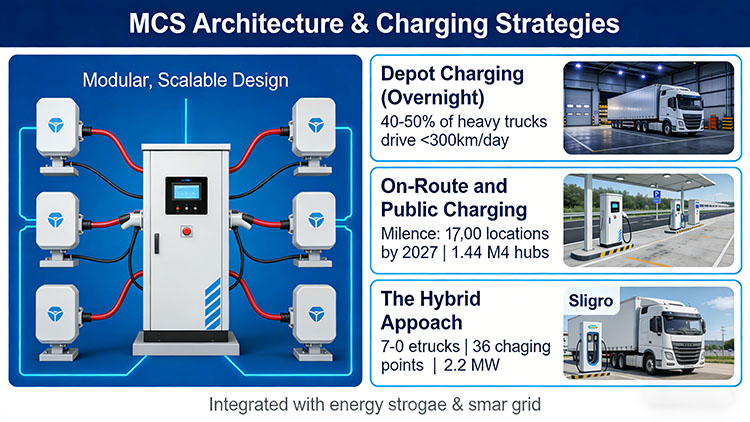
Modern MCS installations feature a modular, scalable architecture. A typical system consists of a centralized power cabinet (often installed remotely from the dispensers) connected to one or more charging satellites via high-power cables. This design allows one cabinet to either deliver full power to a single MCS outlet for ultra-fast charging of one truck, or dynamically distribute power across multiple satellites, enabling concurrent charging of several heavy-duty vehicles or a mix of MCS and CCS-equipped vehicles.
This dynamic load balancing is essential for high-traffic depots, rest areas, ports, and logistics centers, allowing operators to optimize infrastructure use while minimizing energy costs and peak load demands. MCS also integrates well with site-level energy management systems, including battery energy storage, solar generation, and smart grid communication.
Charging Strategies: Depot vs. On-Route vs. Public
Fleet operators face a fundamental decision: where and how to charge their e-trucks. The choice depends on cost, operational needs, depot tenure, and the feasibility of installing charging infrastructure.
Depot Charging (Overnight)
Depot charging—charging battery-electric trucks at logistics depots—is a key lever for decarbonizing road freight transport. Studies show that in major European countries, approximately 40 to 50 percent of heavy trucks drive less than 300 kilometers a day, distances easily covered with battery-electric trucks and night-time charging at the depot.
Depot-based charging provides guaranteed access to infrastructure, reducing anxiety about trucks being delayed at overcrowded public sites and ensuring more reliable timekeeping. It also offers round-the-clock access, opening the door to off-peak charging when electricity prices are lower. By integrating renewables and energy storage assets such as solar panels and batteries, fleet operators can reduce costs and tap into new revenue streams.
However, depot charging requires significant capital investment for infrastructure and grid upgrades. Short depot lease lengths can make installation unviable, as operators need long periods to achieve return on investment. Additionally, logistics companies face severe space and grid capacity constraints when installing charging infrastructure at their depots, particularly in Northern Germany, Italy, Benelux, and Poland.
On-Route and Public Charging
For long-haul journeys, public charging along highways is essential. Milence, a joint venture between Daimler Truck, Volvo Group, and Traton, is building a network of high-performance charging points across Europe, with a target of 1,700 locations by 2027. The company has already deployed Europe‘s first MCS corridor connecting Antwerp to Stockholm, with operational MCS hubs in the Netherlands, Belgium, and Sweden delivering up to 1.44 MW.
Public charging provides greater route flexibility and convenient en route access, helping fleets avoid long lead times for depot infrastructure installation. However, public sites typically charge a premium per unit of energy to recover infrastructure costs.
The Hybrid Approach
Many experts recommend a hybrid model combining depot and public charging. Fleet operators generally benefit from using both, as the combination provides operational resilience. A Siemens project at Sligro in the Netherlands illustrates this approach: 70 electric trucks are charged at 36 points powered by 12 chargers delivering a combined 2.2 MW, integrated with solar panels and an advanced energy management system that balances supply and demand in real time.
Infrastructure Challenges
Despite rapid progress, significant barriers remain to widespread e-truck charging deployment.
Grid Capacity Constraints: The most pressing challenge is grid availability. Distribution and Transmission System Operators unanimously report grid capacity constraints, citing long connection times and coordination challenges. While collaboration with charging point operators is increasing, standardized grid access procedures remain lacking. In Germany, insufficient and difficult-to-access information on available grid connection capacity is a key obstacle, with waiting times for grid connection sometimes extending to several years.
Space and Permitting: Charging point operators face mounting challenges in securing land, permits, and grid access. Most target 1–2 MW per site in the short term, but many question whether this capacity will suffice by 2030, calling for far more ambitious build-out targets.
Retrofitting Limitations: While most truck manufacturers plan to offer MCS-compatible vehicles by 2026, retrofitting existing CCS trucks remains unlikely due to cost and safety constraints. MCS deployment will also require adjustments to thermal systems and battery architecture.
Regulatory Uncertainty: Driver behavior during charging has emerged as a regulatory grey zone. There is no consensus on whether drivers should remain in the vehicle during overnight charging, raising questions about how to reconcile MCS with rest time legislation.
Business Models for E-Truck Charging
The high upfront costs of e-truck charging infrastructure have spurred innovative business models that reduce financial barriers for fleet operators.
Charging-as-a-Service (CaaS)
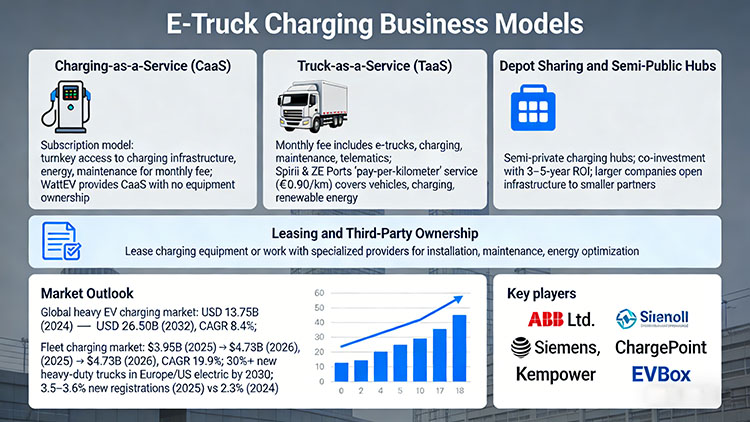
Charging-as-a-Service is a subscription model that provides fleets with turnkey access to EV charging infrastructure, energy, and maintenance support for a predictable monthly fee. This model removes capital barriers and accelerates electric truck adoption by turning charging into a predictable operating expense instead of a costly infrastructure investment.
WattEV, a leading provider, offers a CaaS solution where fleets gain instant access to reliable charging, energy management, and uptime support without owning or operating any charging equipment. The company is building one of the nation‘s largest megawatt-capable electric truck charging networks, designed specifically for heavy-duty fleets.
Truck-as-a-Service (TaaS)
Truck-as-a-Service takes the model further, providing electric trucks, managed charging, maintenance, and telematics for a monthly fee to accelerate fleet electrification. Spirii and ZE Ports have launched a “pay-per-kilometer” service where clients pay a fixed monthly fee based on kilometers driven—approximately €0.90 per kilometer for e-trucks—covering vehicles, charging infrastructure, and renewable energy without any upfront capital.
Depot Sharing and Semi-Public Hubs
Shared private infrastructure networks represent an emerging opportunity. Logistics companies have expressed willingness to co-invest in semi-private charging hubs, provided ROI falls within a 3–5-year window. Larger companies can make their charging infrastructure accessible to smaller partners, while depot owners can create new revenue streams by opening their facilities to approved subcontractors.
Leasing and Third-Party Ownership
Rather than owning charging infrastructure, some fleet operators prefer to lease equipment or work with specialized providers who handle installation, maintenance, and energy optimization. This approach reduces upfront capital requirements and transfers operational complexity to expert partners.
Market Outlook
The e-truck charging market is poised for substantial growth. The global heavy electric vehicle industrial equipment charging market was valued at approximately USD 13.75 billion in 2024 and is projected to reach USD 26.50 billion by 2032, at a compound annual growth rate (CAGR) of 8.4%. The fleet charging market more broadly grew from $3.95 billion in 2025 to $4.73 billion in 2026, a CAGR of 19.9%.
By 2030, industry forecasts suggest that over 30% of new heavy-duty trucks in Europe and the US could be electric or fuel-cell powered. Electric trucks are expected to account for 3.5–3.6% of all new registrations in 2025, up from 2.3% in 2024.
Key players in the e-truck charging ecosystem include ABB Ltd., leveraging extensive expertise in power electronics and automation; Siemens, excelling in integrated charging systems connected to smart grids; ChargePoint, recognized for its expansive charging network and intuitive software; Kempower, supplying modular DC fast-charging systems; and EVBox, known for innovative, modular charging stations.
Smart Charging and Energy Management
Modern e-truck charging is as much about software as hardware. Advanced energy management systems (EMS) are essential for optimizing charging schedules, reducing costs, and managing grid constraints.
Dynamic load balancing intelligently distributes available power to the vehicle that needs it most, prioritizing operational needs while reducing grid burden. By charging during off-peak hours and using smart algorithms to balance loads, depots can avoid expensive demand charges and operate within constrained grid capacity.
Battery energy storage systems are increasingly integrated with e-truck charging infrastructure. Designwerk’s MCS is built as a flexible, containerized solution with integrated battery buffers that allow peak-shaving to reduce grid impact, enable use of local renewable energy, and even incorporate second-life batteries from decommissioned commercial vehicles—eliminating the need for grid expansion at depots.
The Siemens Sligro project demonstrates that large electric fleets are feasible even under constrained grid conditions, provided that charging and energy use are tightly coordinated. The system ensures trucks are charged on schedule while keeping the facility‘s overall load within capacity, integrating solar power whenever available to cut costs and emissions.
The Future of E-Truck Charging
Several transformative trends are shaping the next decade of e-truck charging.
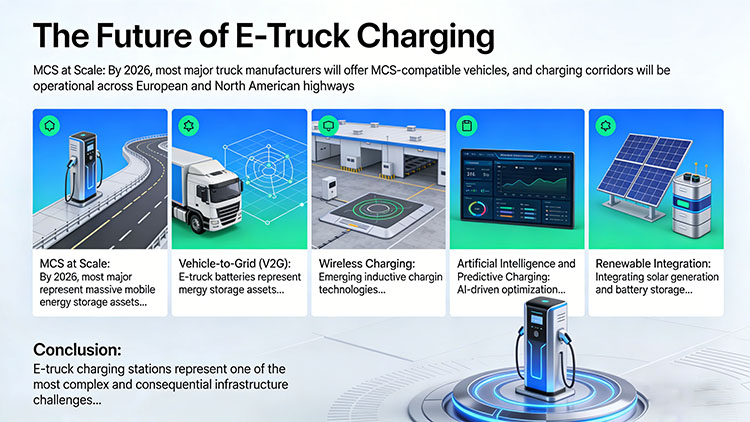
MCS at Scale: By 2026, most major truck manufacturers will offer MCS-compatible vehicles, and charging corridors will be operational across European and North American highways. The EU’s TEN-T network already requires deployment of 350 kW truck charging stations every 100 kilometers, driving rapid infrastructure expansion.
Vehicle-to-Grid (V2G): E-truck batteries represent massive mobile energy storage assets. Through V2G technology, fleets could charge during low-demand periods and discharge stored energy back to the grid during peaks, creating new revenue streams while supporting grid resilience.
Wireless Charging: Emerging inductive charging technologies could enable opportunity charging at depots and loading docks without physical connections, streamlining operations and reducing maintenance.
Artificial Intelligence and Predictive Charging: AI-driven optimization will increasingly manage charging schedules based on real-time energy prices, grid conditions, weather forecasts, vehicle departure times, and route demands, further improving profitability and reliability.
Renewable Integration: Integrating solar generation and battery storage with e-truck charging infrastructure will become standard practice, enabling depots to operate as energy hubs rather than just consumption points.
Conclusion
E-truck charging stations represent one of the most complex and consequential infrastructure challenges of the energy transition. Unlike passenger EV charging, which has largely adapted existing technologies, e-truck charging requires purpose-built solutions: megawatt power levels, standardized high-current connectors, intelligent load management, and business models that overcome substantial upfront capital requirements.
The Megawatt Charging System (MCS) has emerged as the foundational standard, with major OEMs, infrastructure providers, and policymakers aligned behind its deployment. Real-world demonstrations have proven that 1 MW+ charging is not only feasible but reliable, enabling 40-tonne electric trucks to charge within mandatory driver breaks—a critical milestone for long-haul freight electrification.
With the global market for e-truck charging infrastructure growing rapidly, innovative business models such as Charging-as-a-Service and Truck-as-a-Service are removing financial barriers and accelerating adoption. The road ahead remains challenging—grid constraints, regulatory uncertainty, and infrastructure costs demand coordinated action from industry, utilities, and governments. But the direction is clear: the electric truck is coming, and the charging station that powers it will be at the heart of sustainable freight for decades to come.